
Probing a drifting proton-electron mass ratio from H2 spectra
Constant of nature not constant?
Initially in 2006 a team of scientists of the Department of Physics and Astronomy, and of LaserLaB, at VU University Amsterdam, and of the European Southern Observatory in Chile have found indication for a small variation of one of the constants of nature: the ratio between the mass of the proton and the mass of the electron. They had reported this finding in the April 21 issue (2006) of Physical Review Letters, in a paper entitled:Indication of a cosmological variation of the proton-electron mass ratio based on laboratory measurement and reanalysis of H2 spectra (Click to download a free reprint). Previously in an intial report, published in 2004, our group had already made an attempt of determining a constraint on mu-varaiation in the paper: Highly accurate H2 Lyman and Werner band laboratory measurements and an improved constraint on a cosmological variation of the Proton-to-electron mass-ratio.
The scientists at LaserLaB VU and at ESO (in Paranal Chile) discovered indication for such a variation by comparing the proton-electron mass ratio in molecular hydrogen as it is now and how it was 12 billion years ago. They performed extremely accurate measurements on spectral lines of hydrogen molecules in the laboratory and compared the results with the same lines observed in spectra of quasars. Quasars are astronomical objects that emitted light way back in the past (twelve Billion years ago). They are so far distant, that their light reaches the Earth only now. In the 'old light' a fingerprint of molecules of hydrogen or H2, as they were then, is carried to Earthbound telescopes, in this case to the Very Large Telescope in Chile.
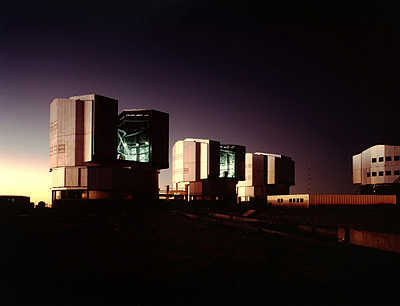
the VLT at Paranal, Chile, at 2.5 km altitude in the Andes
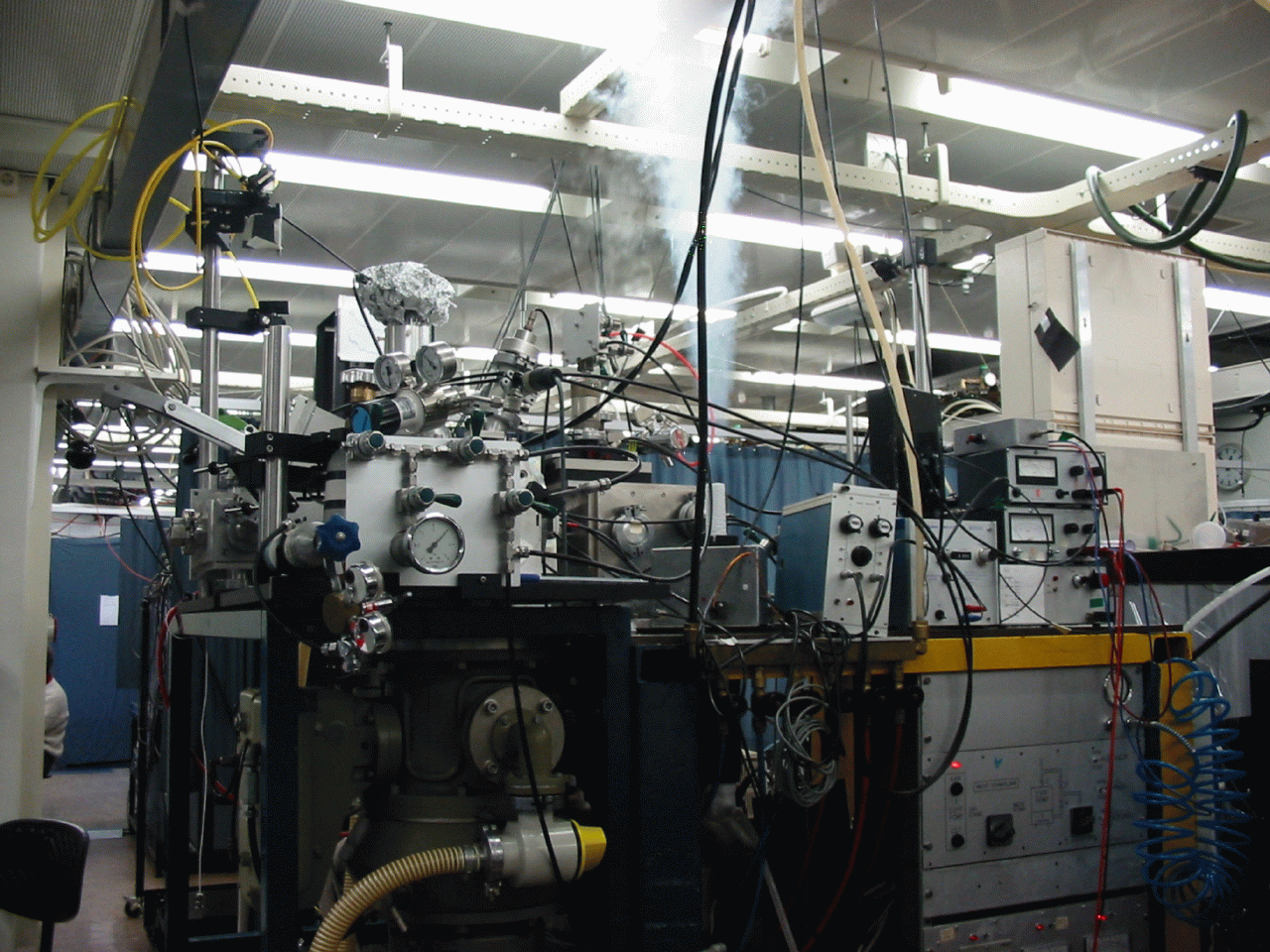
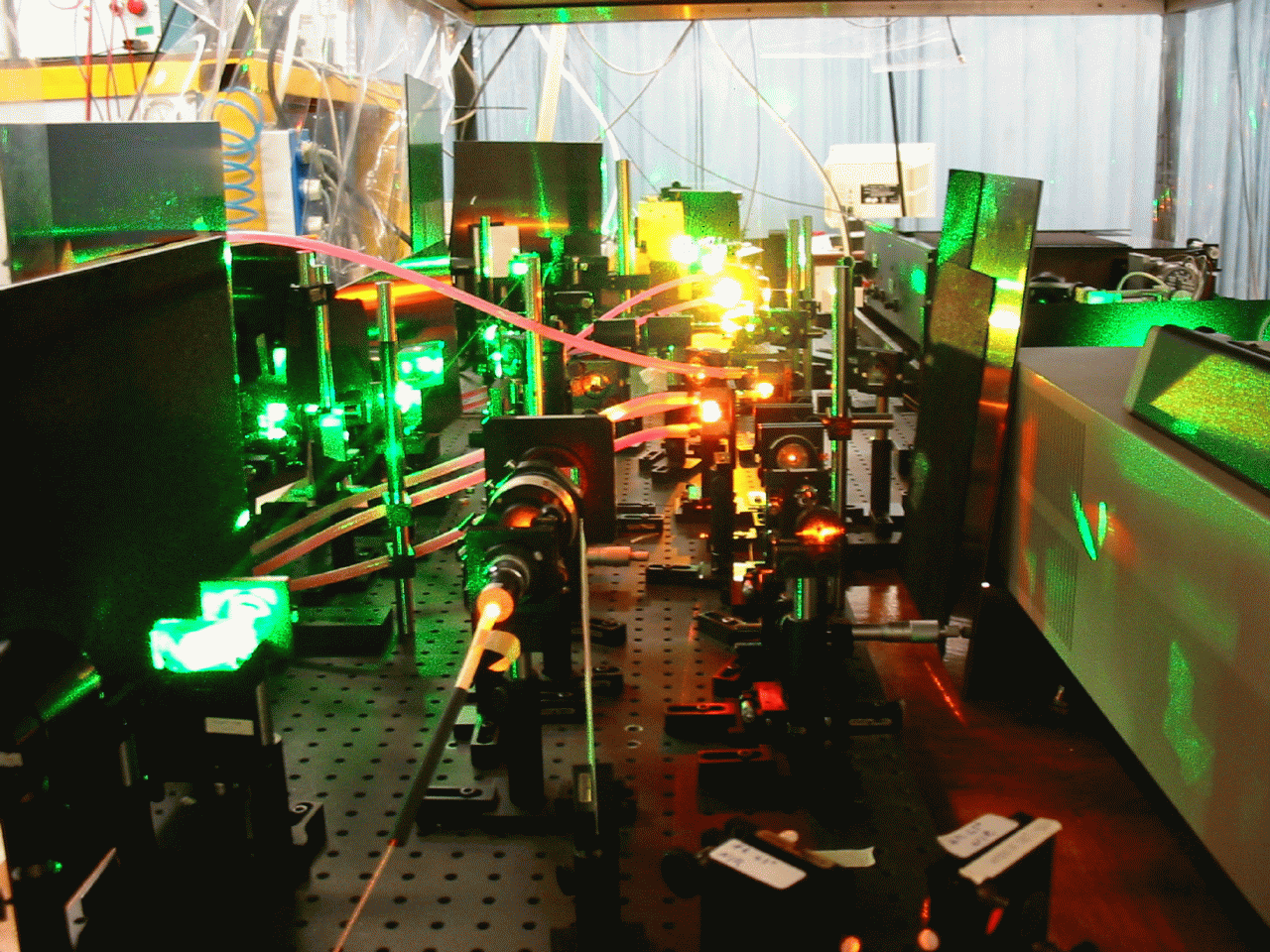
The laboratory measurements were performed with a special laser, developed at LaserLaB VU Amsterdam, operating at the specific wavelengths absorbed by hydrogen molecules. Those wavelengths are in the extreme ultraviolet (XUV) between 90 en 110 nanometer. The beam of XUV-radiation is crossed with a beam of H2 molecules in otherwise vacuum conditions (Click for picture of Vacuum chamber) Some essential parts of the laser setup are displayed below:
 ..
..
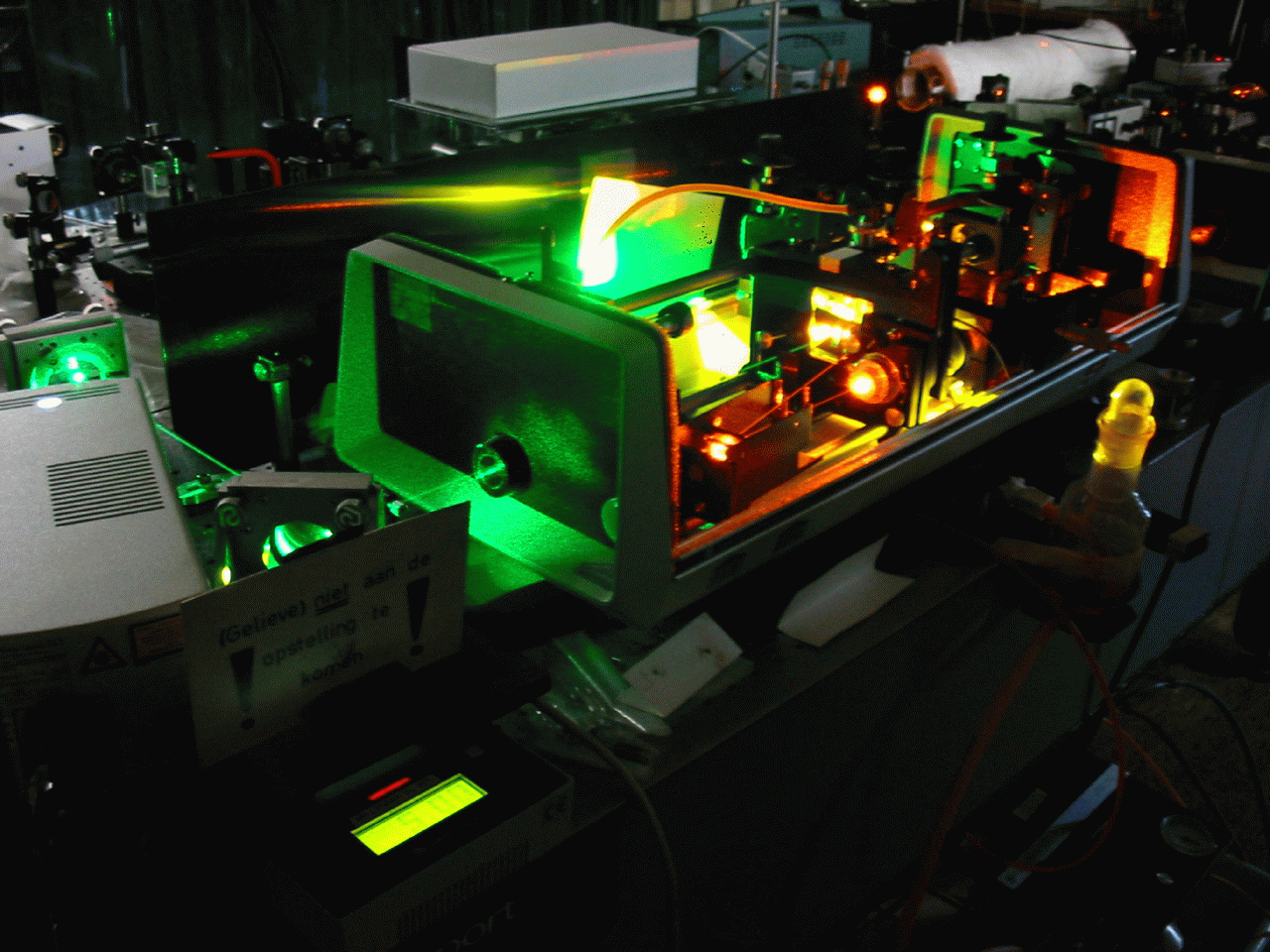
On the left the Pulsed-Dye Amplifier; on the right the ring dyelaser.
(Click on picture for higher pixel size)
In the expanding universe the quasars move away from us (at Earth). As a result of the cosmological redshift all spectral lines are shifted to the visible wavelength domain. Hence the light can penetrate through the Earth's atmosphere, and the spectra can be recorded accurately by means of a spectrometer connected to the telescope. For these observations use was made of the UVES spectrograph:
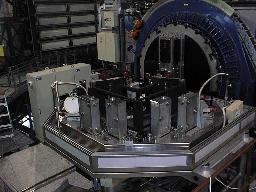
The "Ultraviolet and Visible Echelle Spectrograph".
H2 molecules and the proton-electron mass ratio
The hydrogen molecule, built from two protons and two electrons, is the most abundant molecule in the universe. From a comparison of data obtained via laser spectroscopic measurements and from quasar observations, in combination with calculations of the structure of the H2 molecule, it follows that the mass ratio of the proton and the electron may have changed in the mean time. In the 2006-study indication was found for a mass ratio becoming smaller by 0.002% in the past twelve Billion years. That seems just a little, but according to the laws of physics, this ratio should not vary at all. But it was just a study on a single object. This finding of 2006 was highly cited and had a broad Press coverage.The proton-electron mass ratio is an important fundamental constant of nature. This constant is dimensionless, so independent of any system of units. It is a number that can be measured and the current status is: Mp/me = 1836,1526726. See also the NIST website for the constants. Standard physics does not have an explanation as to why Mp/me has this value, nor can it provide an explanation as to why it would vary. Note that also the possibility of a variation in alpha, the fine structure constant, is a subject of current research. See: A Constant Worthy of the Name.
It is interesting to note in this respect that the German scientist F. Lenz, in the possibly the shortest paper ever to appear in Physical Review argued, that the value for Mp/me, as it was known then in 1951 (1836.12) exactly coincides with 6 times the number pi to the 5th power. The modern value of Mp/me no longer matches such an algebraic relation.
Further observations and results after the initial 2006 result
After the 2006 result on the two quasar systems Q0347 and Q0405 a number of additional high-redhsift H2 absorption systems was investigated, in particular with involvement of the Amsterdam team:J2123-005 at z=2.05 (Keck)
-
This is probably the "best" system, with many H2 and HD lines observed, with a rather strong quasar background source. We received a spectrum observed at the Keck telescope at Hawaii, equipped with the HIRES spectrometer (thanks to Dr. J.X. Prochaska) and analyzed it for a possible mu-variation. The result was published in a publication: Keck telescope constraint on cosmological variation of the proton-to-electron mass ratio.
J2123-005 at z=2.05 (VLT)
-
The same system, because it was "the best absorbing system" was also investigated by us at the Very Large Telescope, leading to the result:
First constraint on cosmological variation of the proton-to-electron mass ratio from two independent telescopes. An important result of the comparitive study is that agreement was found for the two completey independent observations and analyses.
Q2348-011 at z=2.43
-
This system, exhibiting 7 (!) velocity components, was investigated in a visitors mode observation at the VLT in 2007 and analyzed since. Even though 19.5 hours of observation time were spent the resulting signal-to-noise was rather limited; this is due to the weakness of the quasar source. An additional problem encountered was that there are in fact two Dampled Lyman-alpha systems along the line-of sight. This led to a constraint on a drift of the proton-electron mass ratio of only: Dmu/mu = (0.68 +/- 2.78) x 10^-5. The work was published in:
Constraint on a variation of the proton-to-electron mass ratio from H2 absorption towards quasar Q2348-011.
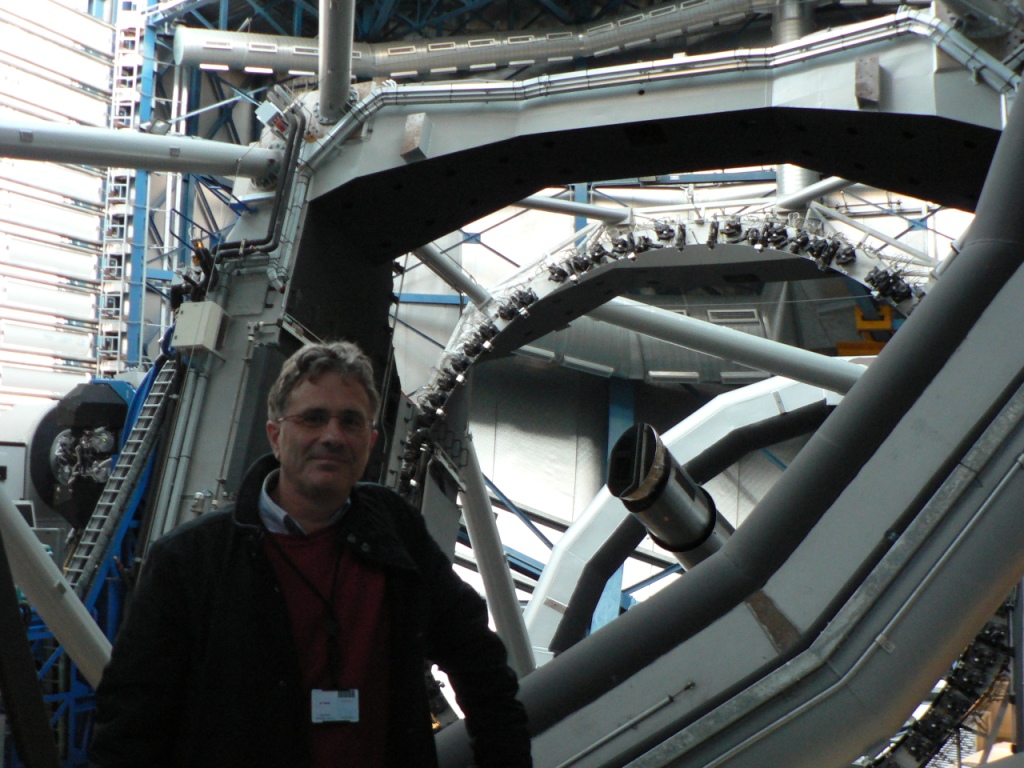
Ubachs at observations at Paranal in 2007
Q0528-250 at z=2.81
-
This system was previously investigated by a number of authors. We reobserved this system at VLT in service mode (program 082.A-0087) on nights 23 and 25 Nov. 2008, 23 Dec. 2008 and 25 and 26 Jan. 2009 with attached Th-Ar calibration files for optimum wavelength accuracy. This study led to the tight constraint: Dmu/mu = (2.3 +/- 2.2) x 10^-6. The work was published in:
New constraint on cosmological variation of the proton-to-electron mass ratio from Q0528-250.
Q0642-504 at z=2.66
-
This study is based on data contained in the ESO Arxiv containing data recorded in 2004 (073.A-0071(A) and 074.A-0201(A) programs) and in 2008 (080.A-0288(A) program). This study led to the tight constraint: Dmu/mu = (12.7 +/- 4.5stat +/- 4.2syst) x 10^-6. The work was published in:
Analysis of Molecular Hydrogen Absorption toward QSO B0642-5038
for a varying Proton-to-Electron Mass Ratio.
Q1443+272 at z=4.22 - the highest redshift system with H2 absorption
-
This study is based on data recorded in a visitor's mode observation campaign at ESO's Very Large Telescope in March 2013 (090.A-0304(A) programs) and on ESA archival data from 2004 (072.A-0346(B) program). This absorption system is the one covering the largest look-back time toward the origin of the Universe. The absorption redshift of z=4.22 (the J1443+272 quasar source emitting at z=4.42) corresponds to a lookback time of 12.4 Gyrs. So the hydrogen molecules and their host galaxy were observed wheh the Universe had 10% of its age now. This study yields the tight constraint: Dmu/mu = (-9.5 +/- 5.4stat +/- 5.3syst) x 10^-6. The work was published in:
Constraint on a varying proton–electron mass ratio 1.5 billion years after the Big Bang.
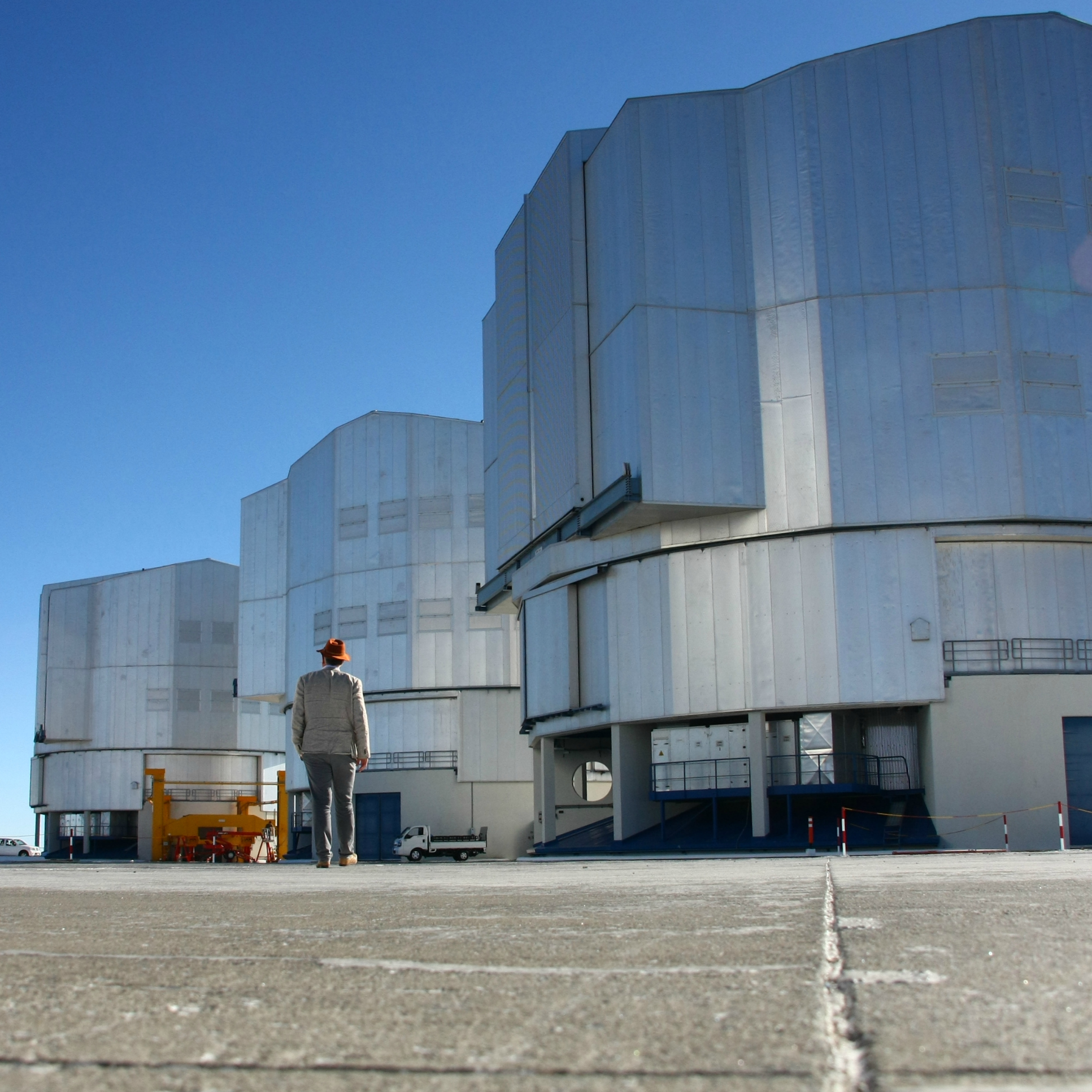
Observations at Paranal in March 2013 by Ubachs and Bagdonaite
Status on mu-variation on a cosmological time scale
Combining the available information on highly redshifted H2 absorption systems this leads to the following situation, as shown in the graph.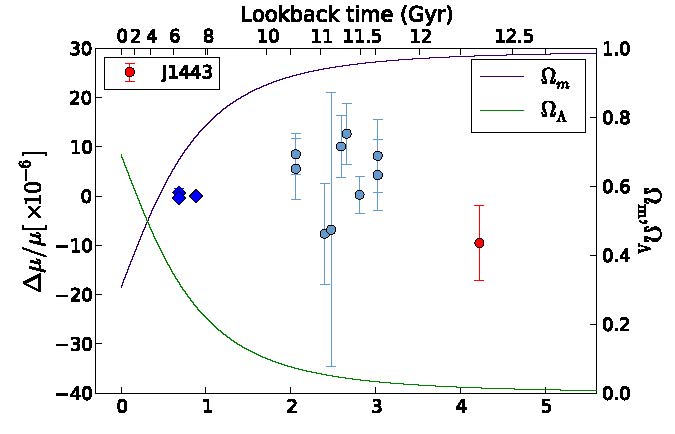
Status of mu-variation from highly redshifted H2 absorbers
The various observations of H2 in the redshift range z=2-4.2, corresponding to lookback times of 10-12,5 billion years show that the proton-electron mass ratio has change by less than 0.001%. The plot shows also the evolution of the Universe with a differing ratio of Dark Energy over Matter. Theories predict that, under the assumption that Dark Eenergy consists of a dynamical quantum field (rather than a non-active cosmological constant), in the form of a scalar field soemtimes called the dilaton-field, this (quintessential) field phi must couple to matter and that effectively it will force a variation of effective coupling constants of the four known forces. Hence it would be expected that the proton-electron mass ratio would depend on the amoount of Dark Energy in the Universe. One may conclude that the present observations are not sufficiently sensitive to reveal such an effect. Note that the dark blue points at lower redshift relate to observations from radio astronomy.
Mu-variation as a function of gravitational field ?
Where variation of fundamental constants on a cosmological time scale is one issue, there exist theories that predict a dependence of fundamental constants on the "environment", be it the density of matter or gravitational fields; note that the latter would contradict Einsteins Equivalence principle. This phenomenon can similarly be investigated from absorption spectra of molecular hhydrogen. We performed such studies based on spectra of H2 observed in the photospheres of white dwarf stars where extremely high temperatures prevail. It is in itself interesting to analyse these sppectra of hydrogen at such high temperatures. The spectra were recorded with the Cosmic Origins Spectrograph aboard the Hubble Space Telescope in the wavelength range of the vacuum ultraviolet (the Earth's atmosphere is not transparant for such short wavelengths).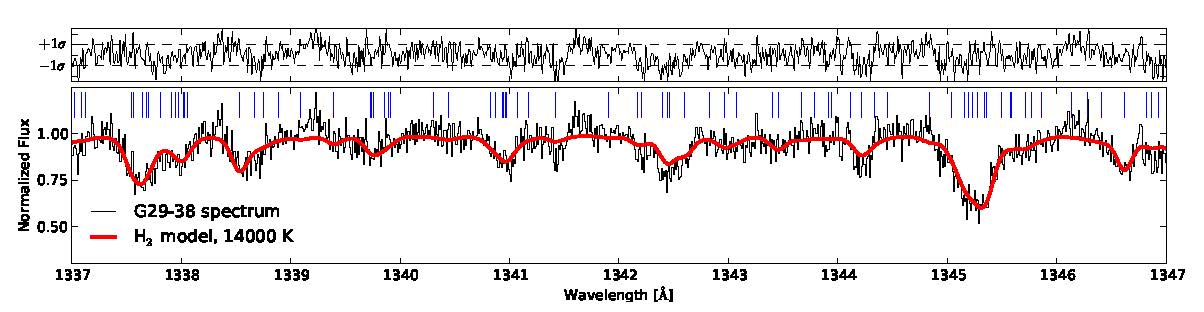
H2 absorption spectrum of the photosphere of the GD29-38 white dwarf
From this study it follows that the proton-electron mass ratio does not change in a gravitational field that is 10,000 times stronger than that on Earth. Under such conditions the fundamental constant mu is equal to that measured in the laboratory within 0.005%. See our Publication on this work. Further information can be found on a Poster. A more detailed study of the molecular spectroscopy of hydrogen including its very high quantum states has been posted on the ArXiv.
Future work
Currently we are focusing on an analysis of the system J1237 that contains absorption imprints of both H2 and CO molecules. A model of a combined analysis is in preparation. We have performed visitor mode observations in 2013 and service mode observations in 2014 on this system. In addition there are archival data available at ESO from 2009. phonebook phonebook |
 Physics Physics |
Chemistry |
FEW |
VU |
site map |
search |
webmaster |
Deze pagina wordt momenteel aangepast aan de nieuwe vormgeving van deze site. Is er iets mis met deze pagina, stuur dan alstublieft een e-mail naar de eigenaar van deze pagina. | |||||||