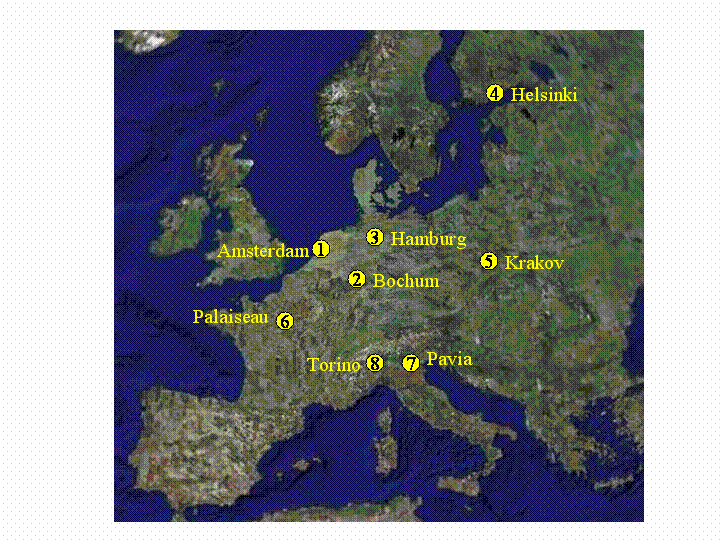
The network is focused on the study of the internal structure of protons and neutrons, and, in general, of hadrons. It combines different approaches, theoretical, phenomenological and experimental, in a field - hadron physics - for which a broad training programme including experimental and theoretical aspects is quite natural. It is here where the strength of the collaborating teams shows up. They have expertise in particle physics phenomenology and they will, organised around eight nodes, create a strong network, intermediating between experimentalists at large and medium-scale facilities and theoretical groups that use more mathematically or computationally oriented methods. The involvement of many of the participants in national training programmes enables them to use those excellent infrastructures in order to create a training environment for a European network of early-stage researchers (ESRs). The important added value from the network consists in the focused and coherent efforts that provide these early-stage researchers with skills that can be used worldwide in state-of-the-art research centres as well as in other high technology sectors of society, such as industrial research labs, medical imaging, information technology or finance.
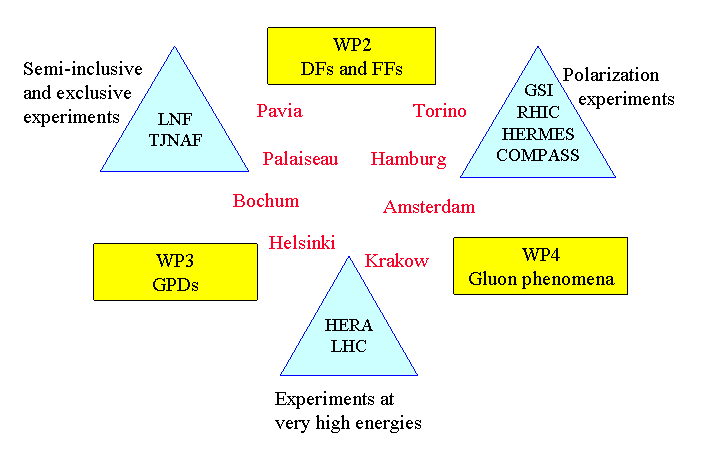
These three tasks represent three complementary ways to attack the
problem of the short distance structure of hadronic matter.
Collaboration of teams which have already made significant
contributions to the field is mandatory to address such a challenging
issue, and is the optimal place to train researchers entering in this
area.

 Proposal
 General
Information (A1)
General
Information (A1)