Open PhD position: how do you make the first antimatter molecule?
Do you want to find out how the first antimatter molecules can be made – using nothing more exotic than hydrogen and a few lasers?
When a proton meets a hydrogen atom, they can occasionally bind into H$_2^+$ by emitting a photon. This is how the first molecules formed after the Big Bang, and it is one of three proposed routes to the first antimatter molecule, $\bar{\mathrm{H}}_2^-$. It has never been measured.
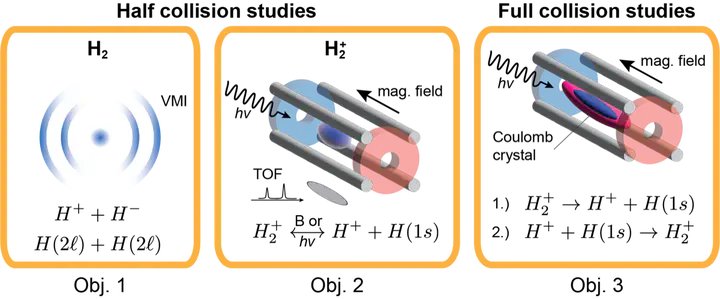
In the SAMURAI project, funded by an NWO Vidi grant, we study these reactions in “half collisions”. We use extreme-ultraviolet lasers to prepare a hydrogen molecule at the exact moment of a collision, watch it come apart, and in the end try to put a cold proton and a cold hydrogen atom together with light in an ion trap.
The position
We have an open PhD position (4 years) in this project. You will build and run experiments with tunable XUV and visible lasers, velocity-map imaging and ion traps, and compare what you measure with quantum-defect and scattering calculations. You will be part of a small group in which experiment and theory go hand in hand, and you will work closely with the other PhD students on both.
Applicants
You should have an MSc degree in physics, physical chemistry or something comparable, and an affinity with lasers, electronics and atomic/molecular physics. Most important is that you are curious, enjoy working in a team, are eager to learn, and like the idea of spending a few years on a question nobody has answered yet.
Application
Please apply via the VU application portal: PhD in experimental physics: how do you make the first antimatter molecule? Applications sent by email cannot be considered.
Your application should include:
- a detailed curriculum vitae,
- a cover letter describing your background, motivation and skills (max. 1 page),
- transcripts with all your grades from your BSc and MSc studies,
- your MSc thesis (or a draft, if it is not finished yet),
- the names and contact details of two references.
For questions about the project, contact dr. M. Beyer: m.beyer@vu.nl
Review of applications will continue until the position is filled. As long as this message is visible, the position is still open.

Maximilian Beyer
Assistant Professor
My research interests focus on precision measurements of simple molecular ions to test quantum electrodynamics (QED) and to search for physics beyond the Standard Model.